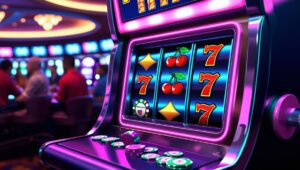
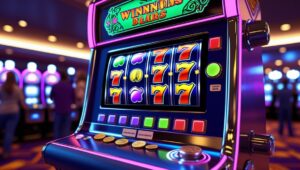
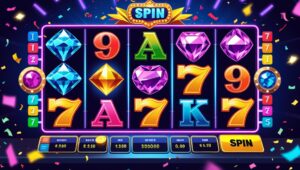
We have all been there. You are watching the reels of a slot machine spin, or perhaps you are waiting for that final card in a game of blackjack. The first two symbols align perfectly—shining 7s or golden bells. The third reel slows down, stutters, and then stops just one millimeter past the winning line.
In a purely logical world, this is a loss. You have lost your stake, and you have gained nothing. However, in the human brain, something far more complex and paradoxical is happening. Instead of feeling the sting of defeat, many players feel a surge of excitement, a rush of “almost,” and a powerful, nearly irresistible urge to press the button again.
This phenomenon is known as the “Near-Miss Effect.” It is one of the most powerful psychological tools in the gambling industry, rooted deep within our evolutionary biology and the intricate pathways of our neurochemistry. Understanding why our brains treat a “close loss” as a “pseudo-win” is the key to understanding the very nature of modern gaming.
A near-miss occurs when a player comes tantalizingly close to a jackpot or a win, but ultimately fails. In the context of a slot machine, it might be two out of three matching symbols on a payline. In a lottery, it might be having four out of six winning numbers.
Mathematically, a near-miss provides exactly the same outcome as a “total miss” (where no symbols match): you receive zero payout. Yet, psychological studies have consistently shown that human subjects do not perceive these two events in the same way. While a total miss is often met with boredom or a desire to stop, a near-miss acts as a secondary reinforcer. It signals that a win is “just around the corner,” even though every spin of a digital machine is an independent event governed by a Random Number Generator (RNG).
To understand why we react this way, we have to look inside the brain, specifically at the mesolimbic dopamine system. This is the brain’s primary “reward circuit,” responsible for the feelings of pleasure and motivation we get from food, social interaction, and winning money.
For a long time, scientists believed that dopamine was only released when we received a reward. However, groundbreaking neuroimaging studies—most notably those involving Functional Magnetic Resonance Imaging (fMRI)—have revealed a more startling truth.
When a player experiences a near-miss, the brain’s ventral striatum and insula (areas associated with processing rewards) light up with an intensity that is remarkably similar to a real win. In many cases, the dopamine spike during a near-miss is actually higher than during a small, insignificant win.
This happens because the brain interprets the near-miss as a “learning signal.” In a skill-based environment—say, practicing archery—a near-miss tells your brain: “You’re doing the right thing, just adjust your aim slightly.” In the world of random gambling, however, there is no “aim” to adjust. The brain is essentially applying an evolutionary survival mechanism to a situation where it doesn’t belong.
Research has highlighted the insula as a key player in gambling behavior. This region of the brain integrates physiological states with emotions. In problem gamblers, the insula is hyper-reactive to near-misses. It translates the visual “almost” into a physical sensation of “being hot” or “being on a roll.”
When the insula is overstimulated, it can override the prefrontal cortex—the part of the brain responsible for logical reasoning and impulse control. This creates a state where the player “knows” they are losing money, but their “gut feeling” (driven by the insula) tells them that the big win is inevitable.
One of the most dangerous aspects of the near-miss is that it fosters an Illusion of Control. This is a cognitive bias where people believe they can influence outcomes that are, in reality, purely random.
In many slot designs, players are given “interactive” elements, such as a “Stop” button that supposedly halts the reels. While these buttons rarely affect the mathematical outcome (which is determined the millisecond the spin starts), they give the player a sense of agency.
When a near-miss occurs after a player has interacted with the game, the brain credits the “closeness” to the player’s own skill. This leads to the Gambler’s Fallacy: the belief that if something hasn’t happened for a while (like a jackpot), it is “due” to happen soon. A near-miss serves as “proof” that the jackpot is currently loading or “warm.”
It is important to understand that in modern casino gaming, near-misses are not always accidental. They are often a result of sophisticated software engineering known as Virtual Reel Mapping.
In the old days of mechanical slots, the number of symbols was limited by the size of the physical reel. If there were 20 symbols, your chance of hitting any one of them was 1 in 20.
Modern digital slots use virtual reels that can have hundreds of “stops.” The software maps these virtual stops onto the physical symbols you see on the screen. To enhance the near-miss effect, developers can program the machine so that symbols adjacent to high-paying icons (like the Jackpot symbol) have more “virtual stops” mapped to them.
This means that while the Jackpot symbol might only appear once on a virtual reel of 100 stops, the symbol directly above it might appear 20 times. Visually, the player sees the Jackpot symbol pass by or stop just one position away far more often than would happen by pure chance. This creates a psychological environment where the player feels they are constantly “teasing” a massive win.
Why doesn’t a near-miss make us give up in frustration? This is explained by the Frustration-Attraction Hypothesis.
A near-miss creates a state of cognitive dissonance. You expected to win (or hoped to), and you were denied at the last second. This creates a mild form of psychological frustration. However, rather than walking away, the human brain seeks to resolve this tension by trying again.
The “closeness” of the loss provides just enough hope to transform that frustration into a renewed drive. It is a cycle of:
Anticipation (The spin starts)
Peak Arousal (The first two symbols match)
Frustration (The third symbol misses)
Resolution Search (The immediate need to spin again to “fix” the loss)
This cycle can lead to a “trance-like” state often referred to as The Zone, where the player loses track of time, money, and their surroundings, driven entirely by the feedback loop of the reels.
The brain doesn’t process near-misses in a vacuum. The environment of a casino—whether physical or digital—is designed to amplify the biological response.
When a near-miss occurs, the machine doesn’t go silent. Often, there is a specific sound effect—a “rising” tone or a dramatic “thud”—that signals how close the win was. Sometimes, the music accelerates as the final reel spins. This sensory input keeps the nervous system in a state of high arousal.
Even the physical feedback, such as the vibration of a smartphone or the haptic response of a cabinet button, serves to “ground” the near-miss as a significant event. By making the “almost win” feel as sensory-rich as possible, the game ensures that the brain records it as a high-priority memory, further encouraging the player to pursue the “missing” reward.
To truly appreciate why we are so vulnerable to this, we have to look back thousands of years. Our brains evolved in an environment where “near-misses” were incredibly valuable.
Imagine an ancestral human hunting a fast-moving animal with a spear. If the hunter throws the spear and it lands just inches away from the prey, that is a near-miss. In this context, the dopamine rush is vital. It encourages the hunter to stay focused, adjust their stance, and try again. The near-miss is a signal of progress.
In the 21st century, we use that same brain to interact with complex algorithms. But the algorithm has no “prey.” It doesn’t care how close you were. There is no progress in a random number generator; the odds of winning on the next spin are exactly the same regardless of what happened on the previous one. Our biological “success-tracking” software is essentially being hacked by modern technology.
The psychological weight of the near-miss has significant implications for how people manage their bankrolls. Research indicates that players who experience a high frequency of near-misses tend to:
Play faster: The time between spins (inter-trial interval) decreases significantly after a near-miss.
Bet larger: In an attempt to “capture” the win that feels imminent, players often increase their stakes.
Play longer: The near-miss acts as a “fuel” for the session, overriding the natural fatigue or boredom that would come from a string of total losses.
For the vast majority of people, this is a fleeting experience that adds to the excitement of the game. However, for those predisposed to gambling disorders, the near-miss effect is a primary driver of “loss-chasing.”
Knowing how the “near-miss” works is the first step in maintaining control. When you understand that your brain is being triggered by an evolutionary glitch, you can begin to view the game more objectively.
Acknowledge the RNG: Remind yourself that every spin is independent. The “closeness” of the symbols on the screen is a visual representation, not a mathematical indicator of your “luck” or how “warm” the machine is.
Monitor Your Heart Rate: If you feel your pulse racing after a near-miss, it is a sign that your insula is taking over. This is the best time to take a five-minute break. Step away from the screen or the machine to let your dopamine levels stabilize.
Set “Hard” Limits: Because the near-miss effect impairs your ability to make logical decisions in the moment, you must make those decisions before you start playing. Use deposit limits and time-out tools to ensure that your “excited brain” cannot override your “rational brain.”
Reframe the Near-Miss: Instead of thinking “I almost won,” try saying out loud, “That was a loss.” By using clear, definitive language, you help your prefrontal cortex re-engage and break the “almost” spell.
The psychology of the near-miss is a masterclass in how human biology can be influenced by design. It turns the logic of mathematics on its head, transforming a negative outcome into a powerful stimulus for continued action.
The “almost win” is a phantom—a trick of the light and a surge of dopamine that convinces us we are mastering a game of pure chance. By recognizing the near-miss for what it truly is—a clever piece of digital sleight-of-hand—players can enjoy the thrill of the game without falling into the biological trap of “just one more spin.”
In the end, the most important thing to remember is that in a world governed by random numbers, “close” only counts in horseshoes and hand grenades. In the world of slots, a near-miss is simply a loss dressed up in a very expensive, very convincing suit. Stay mindful, stay informed, and always play with your head, not just your heart.
Preview Article
The Unwritten Rules of the Gaming Table
Written by
Daniel King
Deep research and a pinch of creativity - these are my secret ingredients in online casino reviews I serve to my readers!
Find Topic-Related Posts On Our Blog